
Blog
Date of Death Valuation vs. Current Market Value: What Probate Requires
Probate and federal estate tax filings require fair market value as of the decedent's date of death, not today's market price or the eventual sale amount. This guide explains the legal standard, the IRC Section 2032 alternate valuation election, and how appraisers reconstruct a value months after the fact.
When someone dies, the value that matters for probate and estate tax purposes is frozen at a single moment: the date of death. That sounds simple until an executor waits four, six, or nine months to order an appraisal, by which point the market for the decedent's coins, art, vehicles, or business interests has moved. This article explains why probate and IRS Form 706 filings require date-of-death fair market value rather than current market value or a later sale price, and how a properly conducted probate appraisal reconstructs that historical figure defensibly.
The Legal Standard: Fair Market Value as of the Date of Death
Probate values a decedent's property at fair market value as of the date of death, not the value on the day the appraiser walks through the house or the price the item eventually fetches at auction. The controlling definition, found in Treasury Regulation 26 CFR 20.2031-1(b), describes fair market value as the price at which property would change hands between a willing buyer and a willing seller, neither being under any compulsion to buy or sell, and both having reasonable knowledge of relevant facts.
That definition does two things that trip people up. First, it fixes the transaction hypothetically on a specific date, the date of death, rather than whenever the appraisal happens to occur. Second, it explicitly excludes a forced sale price. A liquidation auction held under time pressure six months after death does not represent fair market value even if it is a real transaction, because the regulation requires an unhurried, informed exchange.
This date-of-death standard governs both the probate inventory filed with the court and, where applicable, IRS Form 706 for the federal estate tax return. Executors sometimes assume that any recent appraisal will do, or that a real estate listing price or an online marketplace comp is close enough. It usually is not, because "recent" and "as of the date of death" are two different dates once a few months pass. Our probate appraisal services are built specifically to fix a defensible value at that historical date rather than the day the report is written.
Why Today's Market Value Doesn't Satisfy the Requirement
The short answer: current market value only satisfies the probate requirement if today happens to be the date of death. Otherwise, it measures the wrong moment. Estate settlement guidance is consistent on this point: valuation for estate purposes is anchored to the date of death, and any price observed later, whether higher or lower, reflects market movement that occurred after the valuation date, not the value the decedent's property actually carried at death, according to estate valuation guidance from Mason Helmers.
This matters for reasons beyond academic precision. The date-of-death value determines:
- The gross value of the estate, which affects whether federal estate tax filing thresholds are triggered.
- The estate tax liability itself, if the estate is large enough to owe tax.
- The heir's cost basis in inherited property, since federal income tax rules generally give inherited assets a stepped-up basis equal to the property's fair market value on the date of death, according to reporting on inherited property tax rules.
- Probate court fees and equitable distribution among heirs, which typically rely on the inventory value rather than a later sale figure.
Using a current appraisal, a listing price, or an eventual sale price in place of a proper date-of-death valuation creates a mismatch between the number on the filing and the number the law actually requires. That mismatch is exactly what invites scrutiny from a probate court or the IRS.
The Alternate Valuation Date: IRC Section 2032
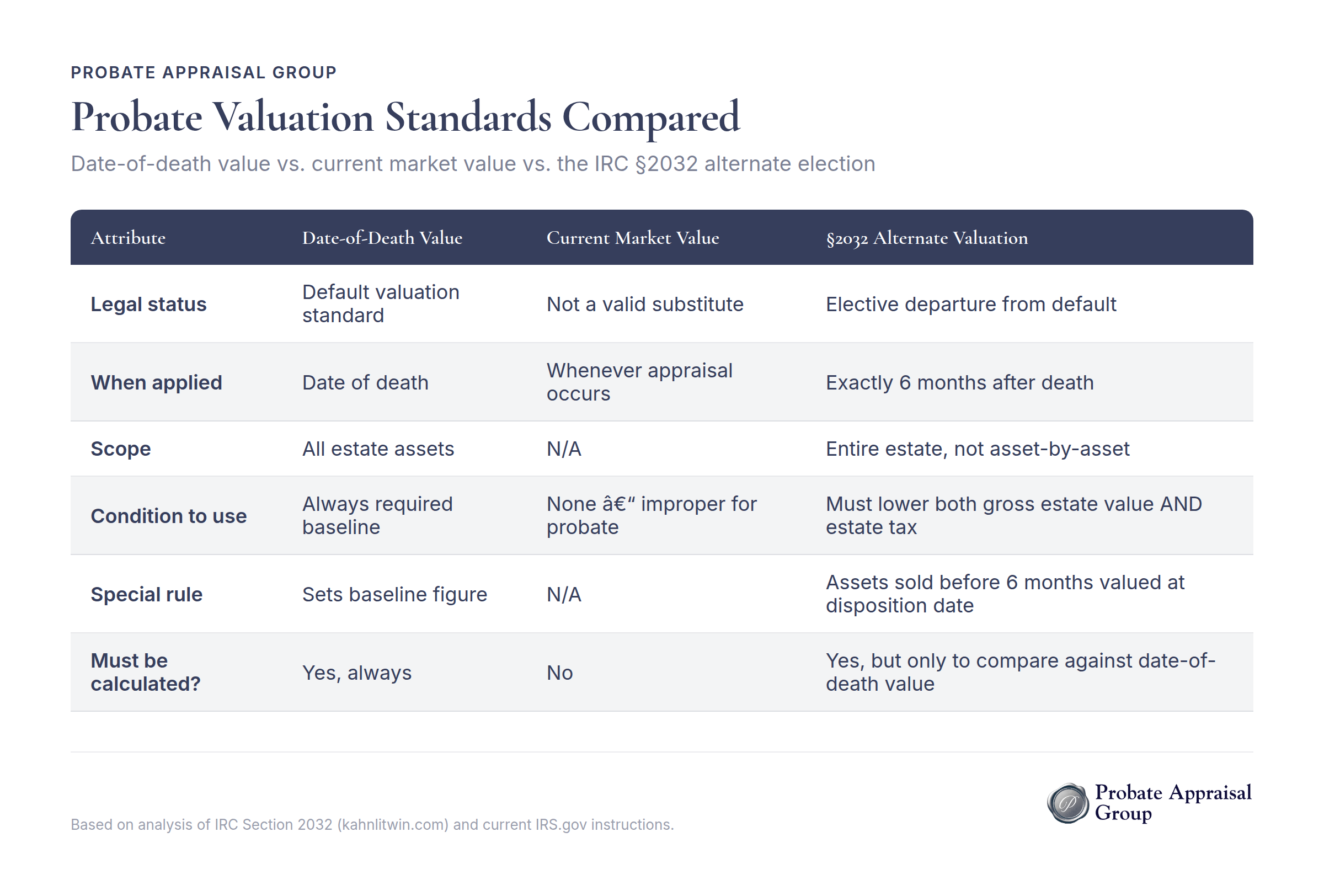
Federal estate tax law does allow one narrow exception. Under Internal Revenue Code Section 2032, an executor may elect an alternate valuation date exactly six months after the date of death, according to analysis of the alternate valuation election. This election exists to provide relief for estates that lose value in the months immediately following death, so the estate is not taxed on wealth that had already evaporated by the time the return is filed.
The election comes with strict conditions:
- It applies to the entire estate, not asset by asset. The executor cannot use the alternate date for a coin collection that dropped in value while keeping the date-of-death value for a house that appreciated.
- It is only available if it lowers both the gross estate value and the resulting estate tax liability. An executor cannot elect the alternate date simply because it is more convenient; it must produce a real tax benefit.
- Assets sold, distributed, or otherwise disposed of before the six-month mark are valued as of their disposition date, not the six-month date, if the election is made.
For guidance on how these elections interact with a specific filing, the IRS publishes current instructions at IRS.gov. The alternate valuation date is a deliberate, elected departure from the default rule. It is never a substitute for getting the date-of-death value right in the first place, since the estate has to calculate both figures to know whether the election even helps.
How Appraisers Reconstruct a Value Months After the Fact
An appraiser assigned to a probate case six or nine months after death cannot simply look at what similar items are selling for today and call it done. The assignment is a retrospective appraisal, meaning the effective date of the report is set in the past even though the fieldwork happens in the present.
To reconstruct that historical value, an appraiser typically:
- Identifies comparable sales that bracket the valuation date. For a coin collection, that means pulling auction results, dealer sell-through records, and price guide data from the weeks immediately before and after the date of death, not from the appraisal date.
- Adjusts for market conditions specific to that window. Bullion prices, collector demand, and auction house activity all shift over months. A watch, vehicle, or artwork that was in a hot market at death and a soft market by the time of the appraisal (or vice versa) needs an adjustment grounded in data from the correct period, not the appraiser's current-day observations.
- Documents the reasoning in the report. A defensible retrospective appraisal shows its work: which comparables were used, why they were selected, and how they were adjusted to the valuation date. This is what allows the report to hold up if a probate court or the IRS asks how the figure was reached.
This is a different skill set than a standard present-day appraisal, and it is why estates benefit from working with appraisers who routinely handle probate and estate tax assignments rather than a generic current-value opinion.
The Executor's Timing Problem
Most of the practical trouble in this area comes down to timing, not law. Executors are often managing grief, a probate court calendar, creditor notices, and a household full of possessions at the same time. Ordering a personal property appraisal frequently slips down the list, sometimes for months.
By the time the appraiser is finally engaged, "today's market" and "the date of death market" can be meaningfully different. If the appraiser (or the executor, trying to save money) simply values the estate as of the appraisal date instead of the date of death, the resulting figure is wrong under the applicable regulation even if every individual price used in the report is accurate.
Watch out: A listing price, an unsold asking price, or a quote from a dealer collected on the day of the appraisal is not a fair market value opinion for probate purposes on its own. It reflects current asking behavior, not a completed, informed transaction as of the required date, and a probate court or the IRS can challenge it on those grounds.
Pro tip: Order the appraisal as early as possible in the probate timeline, even if the inventory filing deadline is months away. The earlier the engagement starts, the easier it is for the appraiser to gather comparables that genuinely bracket the date of death rather than reconstructing a thinner data set from a market that has already moved on.
A Worked Example: Divergence Between Date-of-Death and Later Value
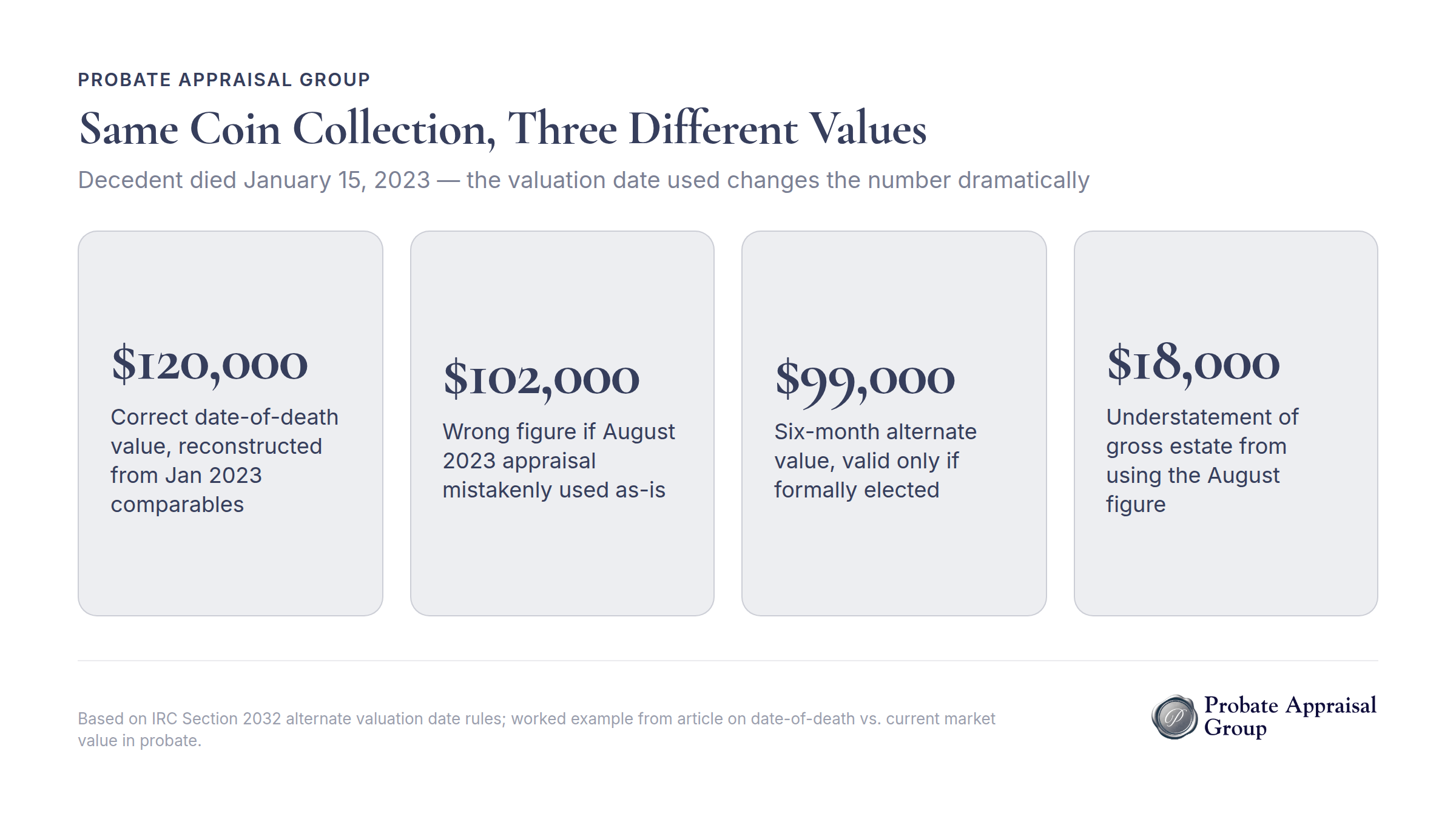
Consider an estate that includes a mid-tier vintage coin collection. The decedent died on January 15, 2023. The executor did not engage an appraiser until August 2023, seven months later.
| Valuation Point | Date | Basis Used | Resulting Value |
|---|---|---|---|
| Date of death (required standard) | January 15, 2023 | Auction results and dealer sell-through data from December 2022 through February 2023 | $120,000 |
| "Current" appraisal if dated to inspection | August 2023 | Comparable sales from summer 2023, after a bullion price decline | $102,000 |
| Alternate valuation date (if elected) | July 15, 2023 | Comparable sales bracketing the six-month mark | $99,000 |
Example: If the executor simply had the collection appraised in August 2023 and reported that $102,000 figure on the Form 706 as though it were the date-of-death value, the estate would understate its gross estate by $18,000 relative to the correct, properly reconstructed date-of-death figure of $120,000. That gap is exactly the kind of discrepancy that draws scrutiny during an estate tax examination.
The correct process instead requires the appraiser to reconstruct the $120,000 figure using comparables from the window around January 15, 2023, regardless of when the physical inspection happens. Only if the executor formally elects the Section 2032 alternate valuation date, and that election lowers both the gross estate and the tax owed, does the $99,000 six-month figure legally replace the date-of-death number. Absent that election, $120,000 is the number that belongs on the filing, not $102,000 and not $99,000.
Getting the Valuation Date Right the First Time
The rule is straightforward even though the mechanics of reconstructing an old value are not: probate and Form 706 filings require fair market value as of the date of death, defined as a willing buyer and willing seller transaction with neither party under compulsion, per 26 CFR 20.2031-1(b). Current market value, listing prices, and eventual sale proceeds are not substitutes for that figure unless the estate formally elects the Section 2032 alternate valuation date and meets its conditions.
An appraiser who regularly handles estate and probate work builds the report around comparables and data from the correct historical window, documents the reasoning, and produces a figure that can withstand review by a probate court or the IRS. Executors who wait to order an appraisal, or who substitute a current-day valuation for convenience, take on real risk of a challenged or rejected filing.
If you are settling an estate and need a defensible date-of-death valuation for coins, jewelry, art, vehicles, or household contents, our team can request an appraisal scoped to your filing deadline and the specific valuation date your case requires.
This article is provided for general informational purposes only and does not constitute legal, tax, or financial advice. Readers should consult a qualified attorney or CPA regarding their specific circumstances.