
Blog
IRS Form 8283 and Estate Donation Appraisals: What Heirs Need to Know
Donating inherited furniture, art, or a vehicle instead of selling it can create a real income tax deduction, but IRS Form 8283 and its appraisal rules decide whether that deduction holds up. This guide covers the $5,000 appraisal threshold, the household-item exception, and how the rules differ for an estate versus an heir who donates.
Heirs who inherit furniture, artwork, collectibles, or a vehicle through probate face a simple choice once the estate settles: keep it, sell it, or give it away. Donating contents you don't want to a qualified charity can create a real income tax deduction, but the IRS ties that deduction to specific reporting and appraisal rules built around IRS Form 8283. Whether the estate or the heir claims the deduction, and what has to back it up, depends on timing, value, and the type of property involved. Our probate appraisal team helps executors and heirs sort out that documentation before a return is ever filed.
Who Claims the Deduction: the Estate or the Heir?
The answer turns on one fact: who owned the property at the moment it was donated.
If the estate itself donates property before distribution (often because the will names a charity as a beneficiary, or the executor decides to give away contents nobody wants), the estate claims the charitable deduction on its own fiduciary income tax return, IRS Form 1041. The appraisal and Form 8283 rules attach to that return and its filing deadline.
If the property is distributed to an heir first, and the heir personally decides to donate it later, the heir claims the deduction on their individual return instead. The appraisal timing rule then runs against the heir's own filing deadline, not the estate's, and the heir, not the estate, signs as the donor on Form 8283.
This is a separate question from the appraisal a probate court may require for the estate's inventory, which values assets as of the date of death for estate administration purposes. A charitable donation appraisal values the property as of the date it left the donor's hands for the charity, which is often months or years later and can produce a very different number.
Key takeaway: Figure out who owns the property at the moment of donation before anyone worries about appraisals. That answer determines whose tax return carries the deduction and whose filing deadline controls the appraisal timing rule.
When Does the IRS Require a Qualified Appraisal for Donated Estate Contents?
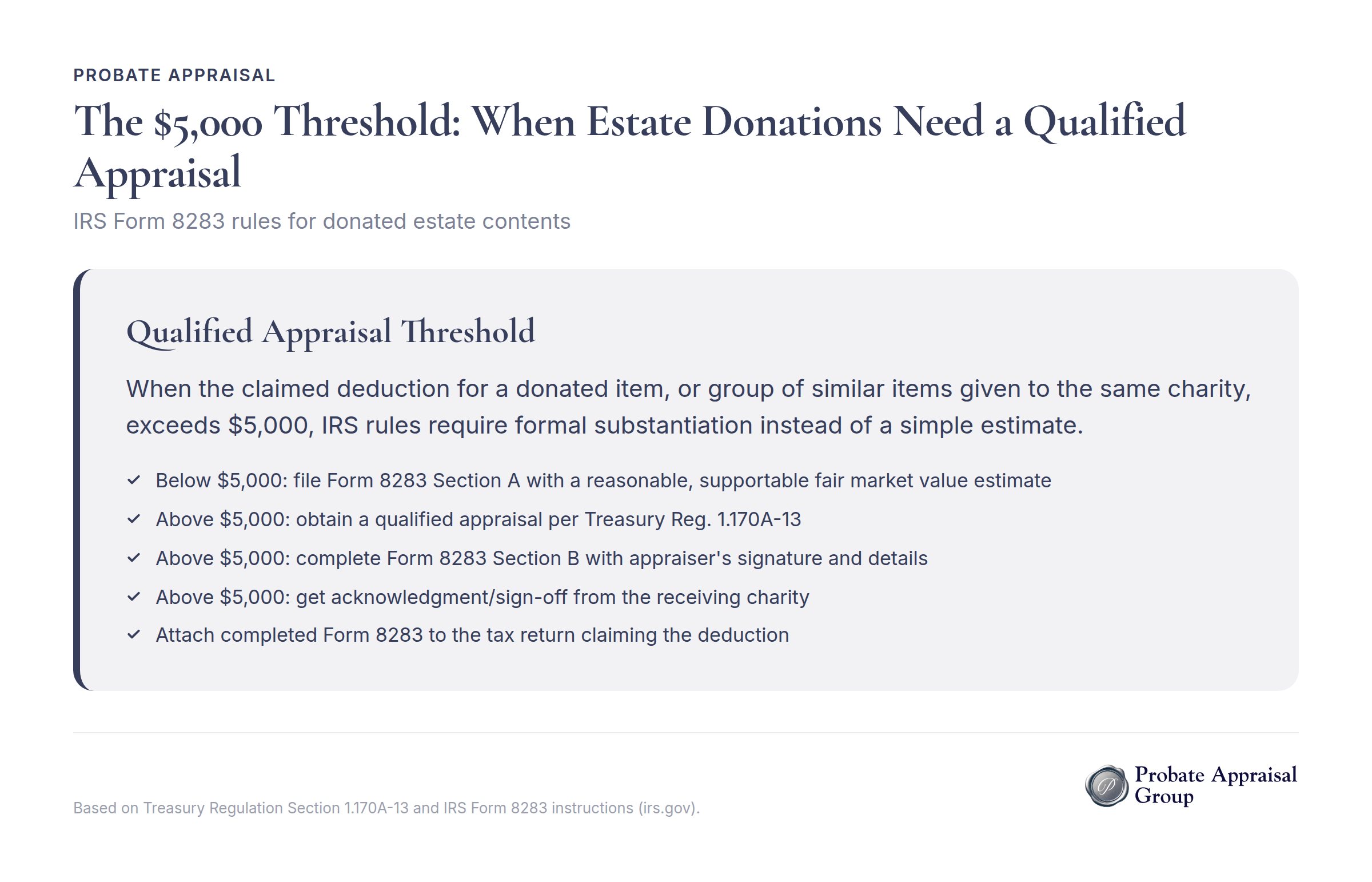
A qualified appraisal is generally required whenever the claimed deduction for an item, or a group of similar items donated to the same charity, exceeds $5,000. Below that figure, most estate content donations only need a completed Form 8283 Section A and a reasonable, supportable estimate of fair market value.
Once the claimed deduction for an item or group crosses $5,000, the rules tighten considerably. The donor must:
- Obtain a qualified appraisal from a qualified appraiser, prepared according to the requirements in Treasury Regulation Section 1.170A-13, which spells out what the appraisal must describe, what methodology it must disclose, and who is qualified to sign it.
- Complete Section B of Form 8283, which requires the appraiser's signature and identifying information, along with acknowledgment from the receiving charity in most cases per the Form 8283 instructions.
- Attach the completed Form 8283 to the return claiming the deduction.
For estate contents specifically, this threshold rarely comes up for a single donated lamp or bookshelf. It comes up fast for a matched furniture set, a coin or stamp collection, a group of paintings, or any collectible category where several pieces from the same estate go to the same charity in the same year.
The Household Item Exception: Furniture and Clothing in Estate Clean-Outs
Estate clean-outs run into a rule that trips up a lot of well-meaning heirs. Clothing and household items (furniture, appliances, linens, and similar goods) generally cannot be deducted at all unless they are in good used condition or better, as described in IRS Publication 526.
There's one narrow exception, and it requires an appraisal even below the usual $5,000 line: if you claim a deduction of more than $500 for a single item of clothing or household goods that is not in good used condition, you must obtain a qualified appraisal and attach it, along with Form 8283, to your return. This rule dates to the Pension Protection Act of 2006 and exists specifically to stop donors from claiming inflated values for worn-out furniture and clothing they would otherwise have thrown away.
For an heir clearing out a decedent's home, this means the average box of clothing donated to a thrift store rarely needs anything more than a receipt. But a damaged antique dresser, claimed at $800 because of its age rather than its condition, needs a qualified appraisal to support that number. Our guide on how to value household goods for probate covers the valuation approach in more depth.
Watch out: Sentimental value and age don't establish fair market value on their own. A worn or damaged item claimed above $500 needs a qualified appraisal, not just a family estimate of what it "should" be worth.
Grouping Similar Items Under One Appraisal
Estates rarely donate a single object. More often it's a set: a dining room suite, a run of hand tools, a shelf of first-edition books, or several pieces of jewelry from the same collection. The IRS allows donors to group similar items of property contributed to the same donee in the same tax year and cover them with a single qualified appraisal and one Form 8283, as long as the appraisal documents the required information for each item in the group, per the Form 8283 overview.
Within that group, the appraiser can lump together items with a collective value of $100 or less rather than itemizing each one individually. This matters for estate contents, where a single donation might include a few dozen small collectibles alongside a handful of higher-value pieces.
Example: An heir donates a set of 12 dining chairs, a sideboard, and a decorative mirror from the same estate to one charity in the same year. If the combined claimed value exceeds $5,000, one qualified appraisal covering the whole group, with each piece described and valued, satisfies the requirement rather than requiring a separate appraisal for each item.
Appraisal Timing: It Doesn't Have to Happen Before You Donate
A qualified appraisal for a donated item does not need to be completed before, or even on, the date of the donation. It has to be made no earlier than 60 days before the contribution date, and it must be in the donor's hands no later than the due date (including extensions) of the return on which the deduction is first claimed, according to IRS Publication 561.
That gives heirs and executors real flexibility. If an heir donates furniture in March but doesn't file their return until the October extension deadline, there's time to get the appraisal done properly rather than rushing it before the donation truck leaves the driveway.
Pro tip: Don't wait until the appraisal is overdue to start looking for an appraiser. Qualified appraisers who understand estate contents, furniture, art, and collectibles get booked out, especially close to tax deadlines, so build in a few weeks of lead time even though the rule gives you until the filing date.
Donating an Inherited Vehicle: a Different Set of Rules
Vehicles inherited through an estate, cars, boats, or even small aircraft, follow a different path than furniture or collectibles. If the donor obtains a contemporaneous written acknowledgment from the charity that meets the requirements of section 170(f)(12)(B), a qualified appraisal generally is not required, according to the Form 8283 instructions.
The tradeoff is that the deduction gets capped at the gross proceeds the charity actually receives when it sells the vehicle, not whatever fair market value an heir might have estimated. If the charity keeps the vehicle for its own use rather than selling it, different rules apply and a qualified appraisal may come back into play.
For an heir who inherited a decedent's car and would rather donate it than deal with a private sale, this usually means the deduction is smaller than a personal-property appraisal might have suggested, but the paperwork is simpler. There's no appraiser to hire, just the charity's written acknowledgment to keep with the tax file.
Worked Example: Donating Inherited Furniture and a Collectible Clock
Example: An heir inherits a bedroom furniture set and a 19th-century mantel clock from a parent's estate. Neither piece has strong sentimental value to the heir, and rather than list them for sale, the heir donates both to a qualified local charity in the same tax year.
A qualified personal property appraiser values the furniture set at $4,200 and the clock at $2,300, for a combined claimed deduction of $6,500. Because the clock and furniture are donated to the same charity in the same year and their combined value exceeds $5,000, the IRS treats this as a group requiring a single qualified appraisal rather than two separate ones.
The heir's appraiser documents both items in one report, including condition, valuation method, and the appraiser's qualifications. The heir completes Section B of Form 8283, the appraiser signs it, and the charity acknowledges receipt. The heir attaches Form 8283 to their individual return but does not need to attach the appraisal itself, since the combined donation is furniture and a clock rather than art valued at $20,000 or more.
The lesson here isn't really about the dollar amount. It's that the combined value of similar items donated together, not the value of any single piece, is what triggers the qualified appraisal requirement.
What Attaches to the Tax Return (and What Doesn't)
In most cases, donors attach Form 8283 to their return, not the appraisal itself. The appraisal stays in the donor's records in case the IRS asks for it later.
There are narrow exceptions where the appraisal itself must be attached, most notably for art donations claimed at $20,000 or more. Estate contents like furniture, household goods, and most collectibles typically fall outside that exception and only require the completed Form 8283.
That said, keeping the full appraisal report on file, along with photographs of higher-value pieces, is good practice regardless of what the form technically requires. If a return gets examined years later, a well-documented appraisal is the difference between a defensible deduction and a guess nobody can support anymore.
Getting the Documentation Right Before You Give
Donating estate contents instead of selling them can be the easiest way to deal with property nobody in the family wants, and it can produce a real deduction for the estate or the heir who makes the gift. But the IRS doesn't take a donor's word for the value once the deduction crosses $5,000, or $500 for a worn household item. A qualified appraisal, properly timed and properly documented on Form 8283, is what turns a good intention into a deduction that survives scrutiny.
If you're weighing whether to sell, keep, or donate contents from a loved one's estate, our team can prepare the appraisal your donation needs, sized to what you're actually giving away rather than billed by the hour.
This article is provided for general informational purposes only and does not constitute legal, tax, or financial advice. Readers should consult a qualified attorney or CPA regarding their specific circumstances.