
Blog
What Is a Qualified Appraisal for IRS Estate Purposes, and What Must It Include?
A qualified appraisal for IRS estate purposes borrows its only codified federal definition from the charitable-contribution regulations, and executors use that same standard to defend the value of art, business interests, and estate contents on Form 706. Here is exactly what the report must contain and who is allowed to sign it.
An estate that includes a valuable painting, a family business interest, or a farm eligible for special-use valuation has to answer the same question a charitable donor does: what is this worth, and who says so? The IRS never wrote a separate rulebook for that answer on the estate tax return. Executors and appraisers instead reach for the same codified definition of a qualified appraisal that governs charitable-contribution deductions, because it is the only one that exists in a federal regulation. This guide walks through what 26 CFR 1.170A-17 actually requires, how it maps onto Form 706, and who is qualified, or disqualified, from signing the report.
Our team prepares USPAP-compliant probate appraisal reports for estate contents, art, and closely held interests built to that same regulatory standard, whether or not the specific asset ever technically triggers Form 8283.
Where the "Qualified Appraisal" Definition Actually Lives
The only codified federal definition of a qualified appraisal sits in the regulation issued under Internal Revenue Code Section 170(f)(11), and it was written to govern noncash charitable contribution deductions substantiated on Form 8283. It defines both the qualified appraisal document and the qualified appraiser who may prepare it, and it lays out exactly what the report must contain, who can sign it, and by what date.
Form 706 does not restate this definition anywhere in its instructions. There is no parallel Treasury regulation written specifically for estate tax appraisals. IRS Publication 561 explains the qualified appraisal and qualified appraiser concepts for donated property, including the $5,000 threshold at which a charitable deduction requires one, and estate practitioners apply that same logic by extension when they need to defend a value on an estate tax return.
The connection becomes direct, not just analogous, in one common situation. When an estate makes a charitable bequest of tangible personal property and the estate itself claims a deduction, Form 8283 attaches to the filing and the regulation stops being a helpful reference point and becomes binding law. Our guide to Form 8283 for estate donation appraisals covers that scenario and what the attached appraisal must show.
Key takeaway: The regulation is legally binding for charitable deductions and Form 8283. For most other Form 706 assets, it functions as the recognized professional benchmark rather than a statutory requirement, but IRS reviewers and appraisers alike treat it as the standard to meet.
Why Executors Apply the Same Standard to Form 706
Form 706 rarely uses the phrase "qualified appraisal" outside of charitable bequests, but its instructions expect written appraisal support for several categories of asset: property valued under the special-use election in Section 2032A, closely held business interests, and unique or high-value personal property such as art, jewelry, and antiques. None of those categories trade on an open market with a published price, so the executor has to prove the number some other way.
That is where the charitable-contribution regulation becomes useful even outside its own scope. It is the only place in the federal code where Congress and Treasury spelled out, in detail, what a defensible appraisal report looks like: who can write it, what it must say, and how current it has to be. Appraisers preparing estate reports for date-of-death or alternate valuation purposes routinely build their reports to meet those same elements, because it is the standard an IRS examiner is most likely to recognize.
Watch out: Assuming that because Form 706's instructions don't say "qualified appraisal," a casual valuation will hold up on audit. Special-use property, business interests, and high-value personal property all draw scrutiny, and a report that skips the report-content and appraiser-qualification tests below leaves the estate with little to point to if the IRS pushes back on a number.
What a Qualified Appraisal Report Must Include
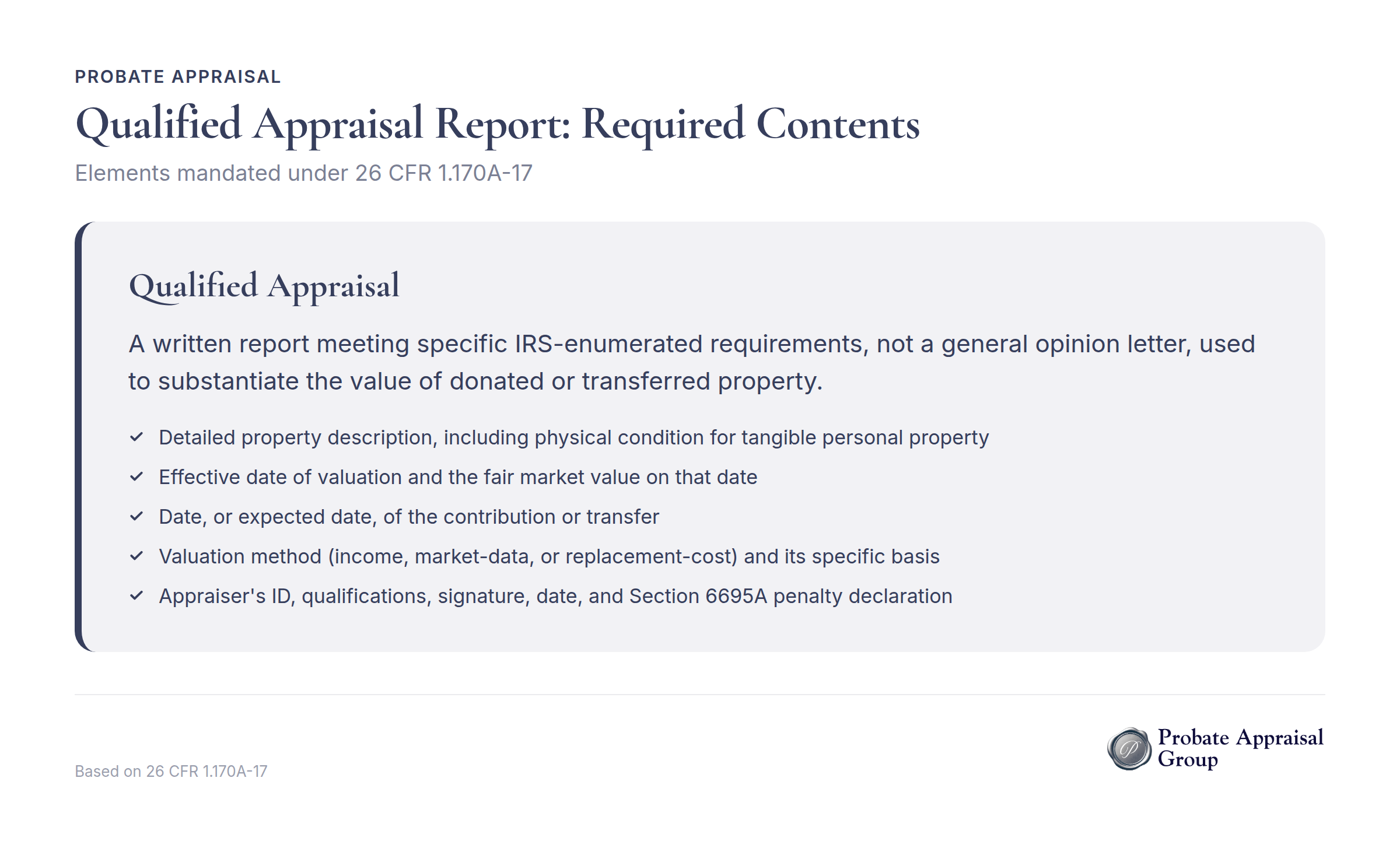
The regulation requires a written report containing specific, enumerated elements, not a general opinion letter. Under 26 CFR 1.170A-17, a qualified appraisal must include:
- A sufficiently detailed description of the property to identify it, including its physical condition for tangible personal property
- The effective date of the valuation and the fair market value on that date
- The date, or expected date, of the contribution or transfer
- Any terms of an agreement relating to the use, sale, or disposition of the donated property, where relevant
- The valuation method used, such as the income approach, market-data (comparable sales) approach, or replacement-cost approach
- The specific basis for the valuation, including any comparable sales data or analysis relied on
- The appraiser's name, address, and taxpayer identification number
- The appraiser's qualifying education and experience in valuing the type of property being appraised
- A statement that the appraisal was prepared for income tax purposes (or the applicable purpose), along with the appraiser's signature, the date signed, and a declaration acknowledging the penalty under Section 6695A for a grossly misstated appraisal
Timing: When the Appraisal Must Be Signed
The regulation is specific about timing for charitable contributions: the appraisal must be signed and dated no earlier than 60 days before the date of the contribution, and no later than the due date, including extensions, of the return on which the deduction is first claimed. That window exists so the valuation reflects conditions close to the transfer date rather than a stale opinion from months or years earlier.
Estate tax valuations don't carry an identical 60-day rule, since Form 706 isn't a charitable-contribution return. What matters instead is that the appraisal's effective date lines up precisely with the legal valuation date, either the date of death or the alternate valuation date under Section 2032, six months later. An appraisal prepared after that date is fine, as long as it values the property as of the correct one.
Who Qualifies as a "Qualified Appraiser"
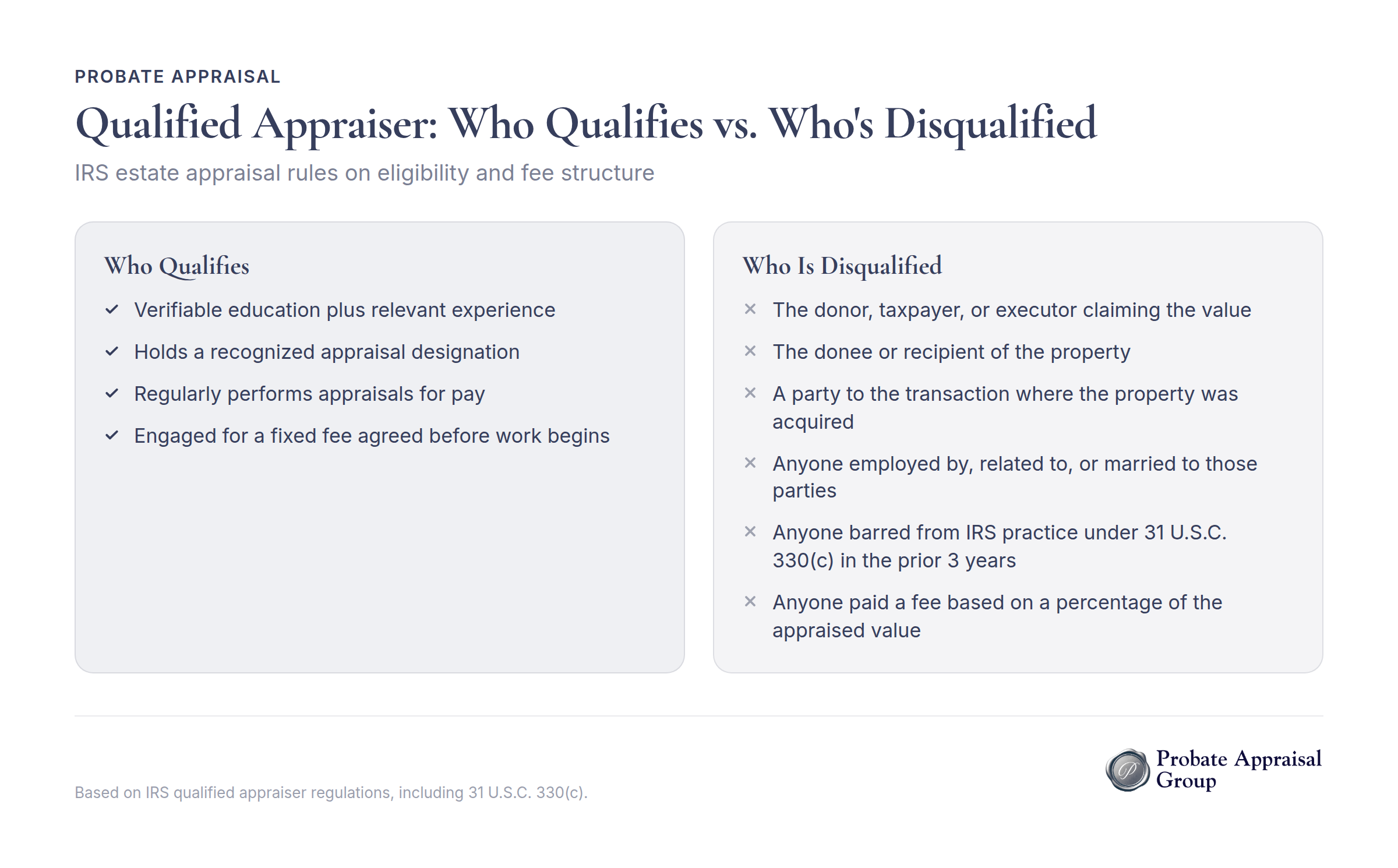
A qualified appraiser must have verifiable education and experience in valuing the specific type of property at issue, established one of two ways: completing relevant coursework and accumulating at least 2 years of experience valuing that property type, or holding a recognized appraisal designation from a professional appraisal organization. The appraiser must also regularly perform appraisals for compensation.
For estate contents, art, and business interests, that credentialing usually points to organizations such as the International Society of Appraisers (ISA), the American Society of Appraisers (ASA), the Appraisers Association of America (AAA), or standards set by The Appraisal Foundation. Reports built to the Uniform Standards of Professional Appraisal Practice (USPAP) satisfy the same underlying expectation the regulation is reaching for: a credentialed, independent professional using an accepted methodology.
Pro tip: If an estate includes several asset categories (say, a home's contents, a coin collection, and a minority interest in a family business), expect to need more than one appraiser. The education-and-experience test is asset-specific, and a generalist credential in one category rarely covers a specialized one.
Who Is Disqualified From Signing the Report
Even a well-credentialed appraiser can be disqualified from a specific engagement. The regulation bars several categories of people from serving as the qualified appraiser for a given property:
- The donor, taxpayer, or executor claiming the value
- The donee or recipient of the property
- A party to the transaction in which the donor or estate acquired the property
- Any person employed by, related to, or married to one of the parties above
- Anyone barred from practicing before the IRS under 31 U.S.C. 330(c) at any point in the three years before the appraisal
The regulation also disqualifies a fee arrangement, not just a person. An appraisal fee calculated as a percentage of the appraised value disqualifies both the appraiser and the resulting report, regardless of that appraiser's credentials. That is one reason legitimate appraisal engagements are quoted as a fixed fee before work begins, never as a percentage of the value concluded and never billed hourly.
Why This Standard Matters for High-Value Estate Assets
The IRS applies particular scrutiny to categories where valuation is inherently subjective. Fine and decorative art valued at $50,000 or more that comes up in an audit gets referred to the IRS Art Appraisal Services program for possible review by the Commissioner's Art Advisory Panel, which underscores how closely high-value personal property valuations get examined once a return is questioned.
Estate planning commentators have made the same point from the practitioner side: because the charitable-contribution regulation is the only detailed, codified definition of a qualified appraisal on the books, it has become the de facto benchmark estate professionals reach for whenever a Form 706 asset needs a defensible number, according to estate planning industry commentary. Closely held business interests, family limited partnerships, special-use farm and ranch property, and unique personal property all fall into that category.
Building an Estate Appraisal That Holds Up
A qualified appraisal for estate purposes is really two things layered together: a legal requirement whenever a charitable bequest and Form 8283 are involved, and a professional best practice everywhere else that a Form 706 asset lacks a public market price. Meeting the report-content, timing, and appraiser-qualification tests in the regulation gives an executor the strongest available answer when the IRS asks how a value was reached.
Our appraisers prepare estate valuations for art, antiques, business interests, and household contents built to this standard from the start. Request an appraisal to scope your estate's specific assets and get a fixed fee before any work begins.
This article is provided for general informational purposes only and does not constitute legal, tax, or financial advice. Readers should consult a qualified attorney or CPA regarding their specific circumstances.