
Blog
Who Can Serve as a Qualified Appraiser for an Estate Under IRS Rules?
The IRS holds appraisers to specific education, experience, and independence tests, and knowing who is disqualified matters as much as who qualifies. This guide breaks down the credentials, conflict-of-interest rules, and fee red flags that determine whether your estate's appraiser will hold up under IRS scrutiny.
When an estate files Form 706 or reports personal property values to the IRS, the question isn't just whether the appraisal report looks thorough. It's whether the person who signed it was legally permitted to sign it at all. A beautifully formatted valuation prepared by the wrong person carries no more weight than a guess, and it can unravel an entire estate filing.
We've covered what a qualified appraisal must include in a separate guide. This one focuses on the person behind the report: who the IRS considers qualified to value estate property, and who is automatically excluded no matter how experienced they are.
What Makes an Appraiser "Qualified" Under IRS Rules?
A qualified appraiser is a paid professional who regularly performs appraisals for compensation, holds verifiable education and experience in valuing the specific type of property at issue, and is not disqualified by a conflict of interest. This definition comes from the Treasury regulation governing charitable contribution substantiation, and it has become the standard the IRS and estate professionals apply across the board, including for estate tax filings.
That last point deserves a plain explanation. The regulation that spells out appraiser qualifications in the most detail, 26 CFR 1.170A-17, technically governs deductions for charitable donations, not estate tax returns. The regulation covering estate valuations is far thinner on appraiser credentials. In practice, IRS examiners reviewing a Form 706, estate planners, and professional appraisal organizations all treat the charitable contribution standard as the working definition for estate personal property too, since it's the most detailed federal test available. If an examiner questions an estate appraiser's credentials, this is the framework they reach for.
The Two Paths to Meeting IRS Education and Experience Requirements
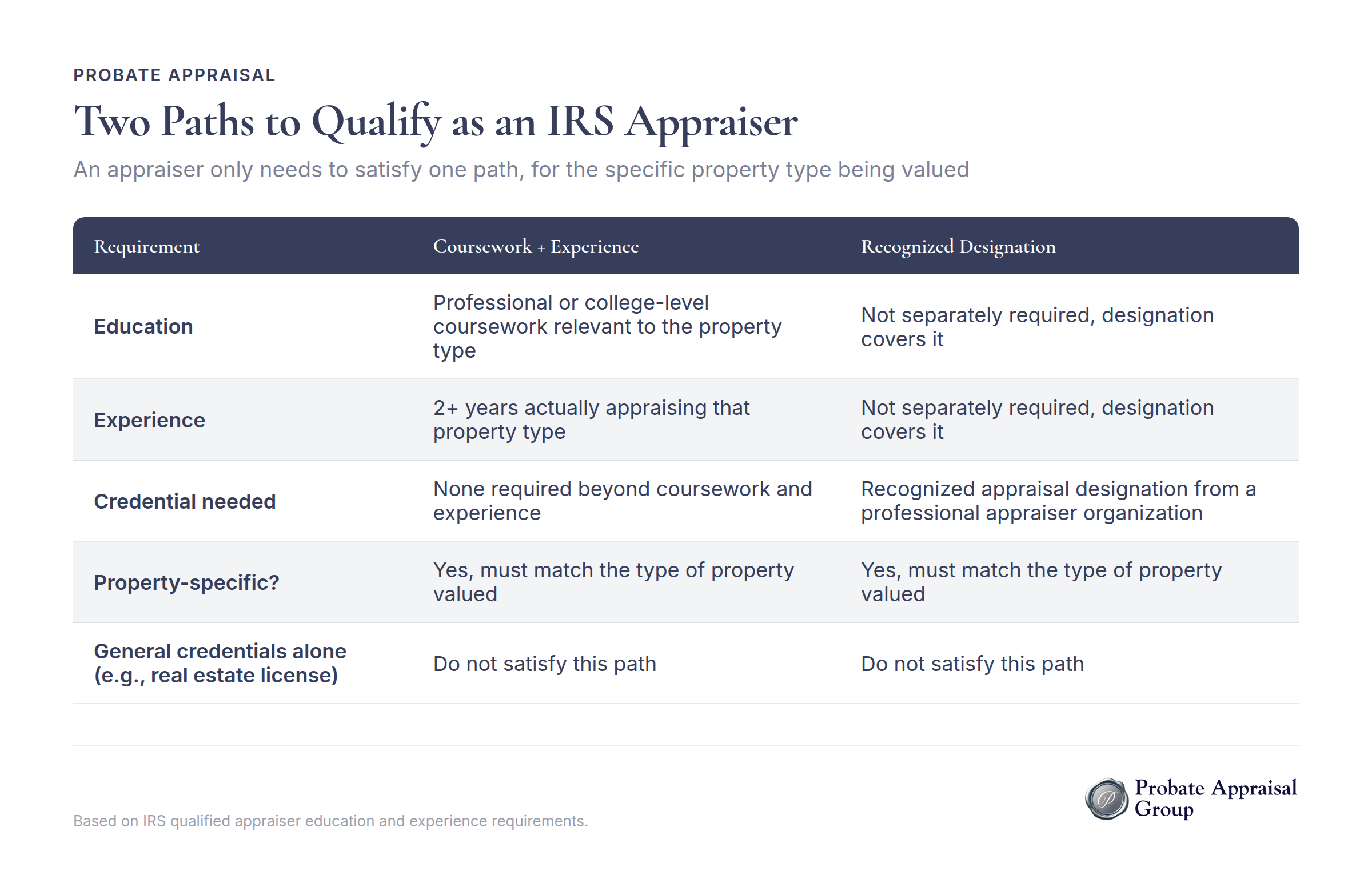
An appraiser satisfies the IRS education and experience test one of two ways. Both are legitimate, and an appraiser only needs to meet one of them for the specific category of property being valued.
- Coursework plus experience: The appraiser has completed professional or college-level coursework relevant to valuing that type of property, and has 2 or more years of experience actually appraising that property type.
- Recognized designation: The appraiser holds a recognized appraisal designation from a professional appraiser organization for that property type, which is generally accepted as satisfying the education and experience requirement on its own.
Neither path is optional window dressing. An appraiser who values real estate every day but has never appraised fine art, jewelry, or a coin collection does not automatically qualify to value those items for an estate, even if they hold an impressive general credential. The IRS test is property-specific, not a blanket professional license. A state real estate license, a general business background, or experience as a tax return preparer does not by itself establish qualification for personal property.
Who Is Excluded from Serving as Your Estate's Appraiser?
An otherwise qualified appraiser can still be disqualified by their relationship to the property or the people involved. In an estate context, this exclusion list functionally rules out most of the people closest to the situation.
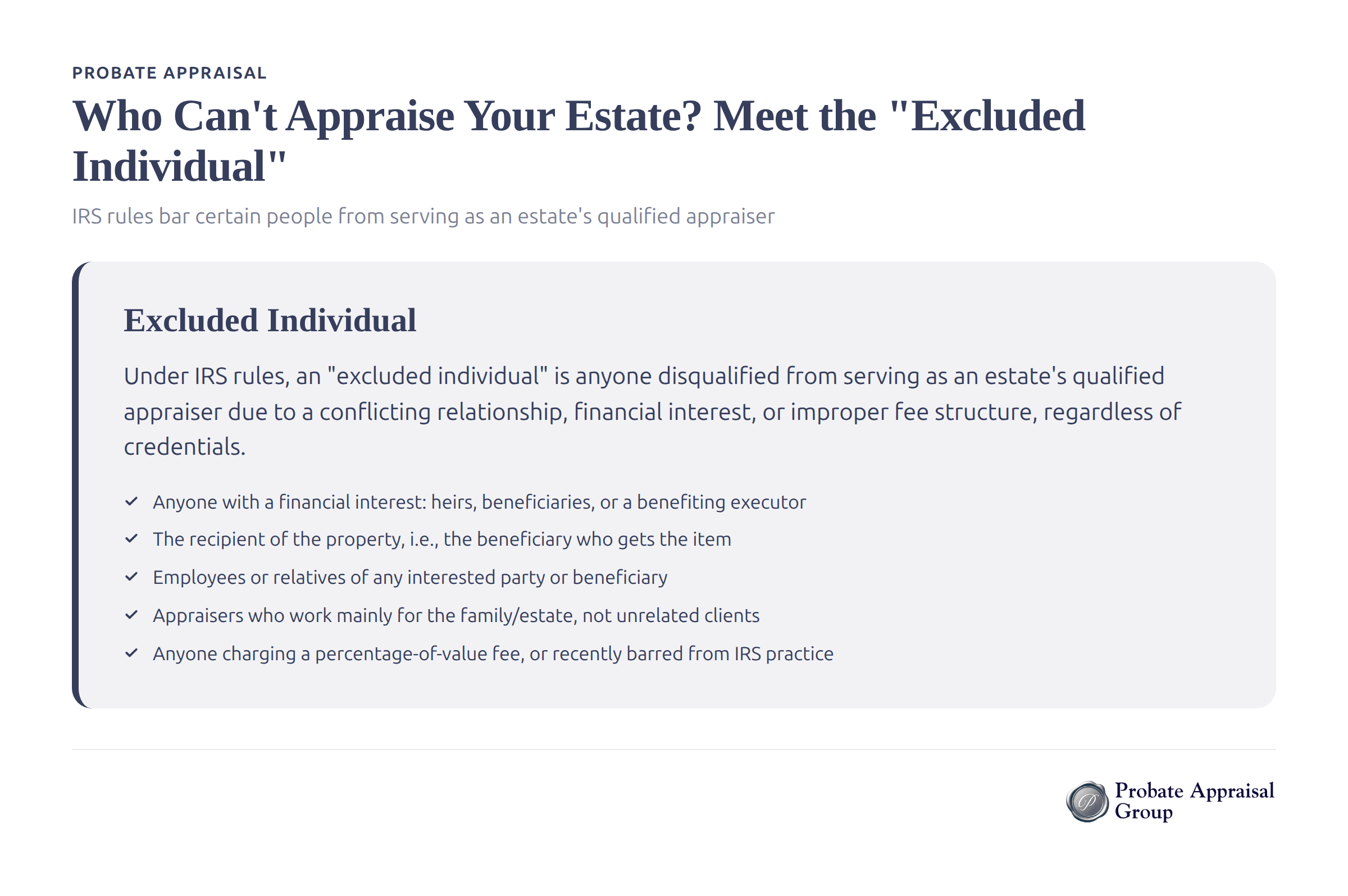
The IRS treats the following as excluded individuals who cannot serve as the qualified appraiser:
- The person with the financial interest, which in a donation context is the donor and in an estate context maps to an heir, beneficiary, or an executor who stands to gain from the value assigned.
- The recipient of the property, such as a beneficiary who will actually receive the item being appraised.
- A party to the transaction in which the decedent originally acquired the property, unless the acquisition happened within 2 months of the appraisal and the value doesn't exceed the purchase price.
- Employees or relatives of any of the above, including family members related closely enough to create an obvious conflict.
- An appraiser who works regularly for the family or estate and does not perform the majority of their appraisal work for other, unrelated clients during the year.
- Anyone who charges a fee based on a percentage of the appraised value, which the IRS treats as a prohibited fee arrangement regardless of the appraiser's other qualifications.
- Anyone barred from practicing before the IRS at any point in the 3 years before the appraisal date.
The practical effect for families is significant. An executor who also inherits under the will, a sibling who happens to be an antiques dealer, or a family friend who regularly values items for the estate without a broader client base can all be disqualified, even with the best intentions.
A Real-World Warning: Independence Failures Get Caught
The Tax Court case Kollsman v. Commissioner illustrates exactly how this plays out when independence is compromised. The estate's expert had valued two paintings for the estate while separately offering to help sell them, a conflict the court found undermined the credibility of the appraisal. The court rejected the estate's supported values and revalued the paintings at nearly $2 million more than the estate's own expert had concluded.
The lesson isn't subtle. An appraiser who stands to benefit from a low value, whether through a future sale, a family relationship, or a percentage-based fee, creates exactly the kind of conflict the exclusion rules exist to prevent. Courts and examiners look past credentials to ask whether the appraiser had any reason to shade the number.
Credentials That Signal a Qualified Appraiser
For personal property (art, jewelry, furniture, collectibles, and general household contents), look for appraisers holding credentials from organizations such as the International Society of Appraisers, the American Society of Appraisers, and the Appraisers Association of America. These organizations, along with The Appraisal Foundation, set the training and ethics standards that IRS examiners and estate attorneys recognize as evidence of legitimate qualification. A detailed writeup from the NAEPC Journal on the role of qualified personal property appraisers echoes the same point: credentials alone don't guarantee a defensible report, but their absence is a red flag.
Every report our appraisers prepare is written to be consistent with the Uniform Standards of Professional Appraisal Practice (USPAP), the standard body of ethics and reporting rules published by The Appraisal Foundation. Our probate appraisal services assign appraisers whose credentials match the specific property type in the estate, not a generalist covering everything from farm equipment to fine jewelry with the same designation.
Estate planning organizations reinforce this same guidance. The American Society of Appraisers' own resources for estate and tax planners note that matching the appraiser's specialty to the asset type is one of the most common gaps that trips up estate filings.
Watch Out for Percentage-Based Fees
A percentage-based fee is one of the clearest disqualifying red flags in the entire framework, and it's worth calling out on its own. If an appraiser offers to charge a cut of the appraised value, walk away. That fee structure is a disqualifying conflict of interest under the exclusion rules, not just a bad business practice.
Legitimate estate appraisals are quoted as a fixed fee after the appraiser scopes the assignment, based on the number of items, the complexity of the property, and the depth of research required, never as a percentage of what the property is worth. If a proposal ties cost to concluded value in any way, that alone should disqualify the appraiser from your consideration before the IRS ever gets involved.
Watch out: an appraiser doesn't need to explicitly call their fee a "percentage" to run afoul of this rule. Any arrangement where compensation rises or falls with the appraised value, including bonus structures or contingent fees tied to estate tax savings, creates the same conflict.
Choosing the Right Appraiser Before You File
Getting the appraiser selection right the first time avoids a much bigger problem later: a Form 706 examiner or probate court questioning the entire valuation and forcing a redo under deadline pressure. Before engaging anyone, confirm they hold a relevant credential for the specific property type, ask directly whether they have any financial relationship to the estate or its beneficiaries, and get the fee in writing as a fixed amount tied to the scope of work.
If you're working through an estate that includes art, jewelry, antiques, or general household contents, our team can schedule a probate appraisal with an appraiser whose credentials match the property in question and who has no financial stake in the outcome.
This article is provided for general informational purposes only and does not constitute legal, tax, or financial advice. Readers should consult a qualified attorney or CPA regarding their specific circumstances.