
Blog
Replacement Value vs. Fair Market Value for Estates: Why the Numbers Never Match
Insurance replacement value and probate fair market value measure two different things, and using the wrong one on an estate inventory or IRS Form 706 can create real compliance problems. This guide explains the gap, works through a real example, and shows executors which number the probate court and IRS actually require.
An executor pulling together an estate inventory often reaches for the easiest number available: the replacement cost listed on the homeowner's insurance policy. It feels authoritative, it's already in writing, and it seems like it should satisfy the court. It doesn't. Insurance replacement value and probate fair market value are built to answer two different questions, and the gap between them can run into the thousands of dollars on ordinary household contents.
This matters because a probate appraisal exists specifically to produce the number courts and the IRS require: fair market value as of the date of death. Getting the standard wrong isn't a technicality. It can trigger a rejected inventory, a corrected estate tax filing, or a dispute among heirs over what the estate was actually worth.
What Is Insurance Replacement Value?
Replacement value is what it would cost to buy a brand-new equivalent item at retail today. It's the figure your homeowners or renters policy uses to set coverage limits, and it has nothing to do with what the item would actually sell for used.
Insurers rely on this standard because their job is to make a policyholder whole after a loss, not to establish what a buyer would pay for a secondhand item in an open market. A related concept, actual cash value (ACV), tries to soften this by taking replacement cost new and subtracting depreciation for age and wear. Even so, ACV is still a cost-based calculation, not a market-based one, and it is not the standard that a probate court or the IRS recognizes for estate purposes (Gordon & Rees Scully Mansukhani analysis of replacement cost insurance). Courts have long recognized that neither pure replacement cost nor pure market value always produces a fair result in an insurance dispute, which is one reason some jurisdictions apply what's known as the broad evidence rule when replacement-based figures don't reflect reality (property insurance valuation analysis).
What Is Fair Market Value for Probate and Estate Tax Purposes?
Fair market value is the price a willing buyer would pay a willing seller in the item's most common secondary market, with neither party under any compulsion to buy or sell and both having reasonable knowledge of the relevant facts. That definition, codified for estate tax purposes at 26 CFR 20.2031-1(b), is the standard every probate inventory and every IRS Form 706 or Form 8283 filing is built around.
The regulation adds an important detail: value is not to be determined by a forced sale, and it must reflect the market in which the item is most commonly sold to the public, not a specialty or wholesale market that happens to produce a convenient number (IRS Publication 561). For a used dining set, that market is the secondary market: consignment shops, estate sales, and resale platforms, not the furniture showroom.
California's probate self-help guidance puts it plainly for executors: each item on the inventory should reflect its fair market value on the date the person died, not what it cost, not what it's insured for (California Courts probate inventory guidance). Every state probate court applies some version of the same standard, even where the procedural forms differ.
Why Replacement Value Is Almost Always Higher
For most household goods, furniture, and everyday personal property, replacement value sits well above fair market value, and the reason is straightforward: retail-new pricing and secondary-market pricing are two different economies. A sofa, a dining set, or a set of kitchen appliances loses a substantial share of its retail price the moment it leaves the store, and used furniture in particular has a thin resale market compared to its original cost.
Fair market value asks what a buyer would actually pay for that specific, used item today in the market where it's normally sold. Replacement value asks what it costs to walk into a store and buy something equivalent, new, right now. Those are rarely close, and for depreciating household categories the gap tends to widen with age.
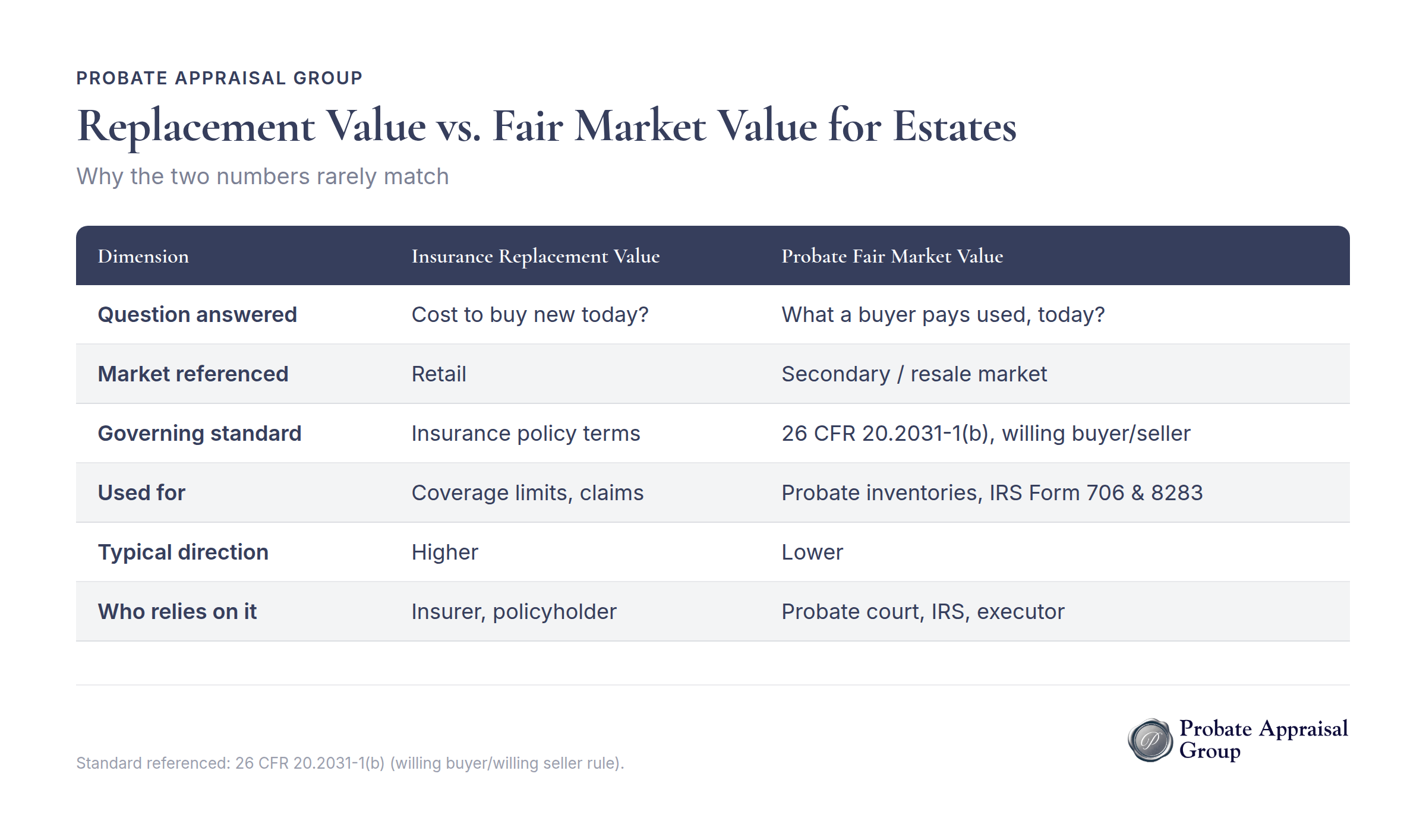
Replacement Value vs. Fair Market Value at a Glance
| Insurance Replacement Value | Probate Fair Market Value | |
|---|---|---|
| Question answered | What does it cost to buy new today? | What would a buyer pay for this item, used, today? |
| Market referenced | Retail | Secondary / resale market |
| Governing standard | Insurance policy terms | 26 CFR 20.2031-1(b), willing buyer/willing seller |
| Used for | Setting insurance coverage limits, claims | Probate inventories, IRS Form 706, Form 8283 |
| Typical direction of gap | Higher | Lower |
| Who relies on it | Insurer, policyholder | Probate court, IRS, executor |
A Worked Example: The $8,000 Dining Set
Example: A decedent's homeowner's policy schedules a dining set at $8,000 in replacement value, the cost of buying a comparable new set from a furniture retailer. The set is 12 years old, shows normal wear, and is a mass-market style with plenty of comparable listings on resale platforms and at estate sales. A qualified appraiser researching the secondary market finds comparable used sets selling in the $900 to $1,400 range.
That $900 to $1,400 range, not the $8,000 replacement figure, is the number that belongs on the probate inventory and on any related IRS filing. If the executor instead submits the insurance schedule as-is, the estate's reported personal property value could be overstated by a factor of six or more on this single item alone, multiplied across every other piece of insured furniture in the house.
Watch out: An estate inventory built from an insurance schedule tends to overstate the estate's personal property value across the board, which can inflate estate tax exposure, distort what heirs believe they're entitled to, and create friction if the property is later sold for far less than the inventory claimed.
The Executor Mistake: Submitting the Insurance List Instead of an Appraisal
It's a common shortcut, and an understandable one. The insurance policy already lists every major item with a dollar figure attached, and an executor juggling a dozen other estate tasks may not realize that number was never meant to represent market value. Submitting that schedule to a probate court, or using it to support values reported on an IRS Form 706 or Form 8283, creates real compliance risk.
A probate court reviewing an inventory built on replacement values may reject it or request a corrected filing once the discrepancy is noticed. On the tax side, the IRS applies the same willing buyer/willing seller standard whether the estate is filing a return voluntarily or because it crosses a filing threshold, and an examiner who spots insurance figures standing in for fair market value has grounds to challenge the entire inventory, not just the disputed line items.
Pro tip: If the estate already has a homeowner's insurance schedule, keep it. It's useful as an inventory checklist of what exists, but it should never be the source of the dollar figures that go on the court filing or the tax return.
Special Cases: Antiques, Fine Art, and Items With No Active Resale Market
Some categories don't fit neatly into either number. Genuine antiques, fine art, and collectibles with a specialized or thin resale market can't be valued by looking up a retail replacement price, and they often can't be valued with a quick comparable-sales search either, because the comparables that exist may not reflect the item's true rarity or condition.
These categories require a qualified personal property appraiser who understands the specific secondary market for that asset type: auction records, dealer networks, and condition-sensitive pricing that a generic online estimate won't capture. This is also where credentials matter. Appraisers affiliated with the ISA, the ASA, or the AAA are trained specifically in researching fair market value for exactly this kind of property, and their reports are built to withstand scrutiny from a probate court or an IRS examiner. The distinction between fair market value and replacement cost is one of the first concepts covered in personal property appraisal training, precisely because executors and even some attorneys conflate the two (ISA overview of fair market value and replacement cost).
Selecting the right market for the appraisal also matters. An item's fair market value should reflect where it's most commonly sold to the public, whether that's a regional auction house, a specialty dealer, or an online marketplace, rather than the most convenient comparable an executor happens to find (ISA guidance on determining fair market value).
Getting the Right Number for Probate
A proper probate appraisal engages a credentialed appraiser to research the secondary market and determine fair market value as of the date of death, a figure the court and the IRS can rely on, and one that has nothing to do with what an insurance policy happens to schedule. For household furnishings, that engagement is typically quoted as a fixed fee based on the number of items and the depth of research required, not on the dollar value the property turns out to be worth, and reports intended to support an IRS filing are prepared to that higher, IRS-qualified standard from the outset.
Executors juggling an estate have enough to track without also reconciling two conflicting valuation standards. Knowing which number belongs where, replacement value with the insurer, fair market value with the court, is one of the simplest ways to keep the process on track. For more on how the date of death valuation standard applies once the estate moves toward closing, or for guidance on how to value household goods for probate, it's worth confirming the approach before any figures go on a court filing.
This article is provided for general informational purposes only and does not constitute legal, tax, or financial advice. Readers should consult a qualified attorney or CPA regarding their specific circumstances.